 Back
Back
Public Company Ad Tech: The Transparency You Must Demand
Julia Dreślińska
2026-06-30
 Read more


Web traffic is not what it used to be. Search referrals are softer, social platforms keep more of their users inside, and AI-driven answers increasingly resolve queries before a single click reaches a publisher. For most sites, the chart that matters most, total monthly sessions, is trending the wrong way. And when sessions shrink, so does the total number of ad requests a Domain can produce. Fewer ad requests means fewer auctions, and fewer auctions means less revenue, even if eCPMs hold steady.
This is where declining traffic ad revenue becomes a structural problem, not a marketing one. You cannot out-sell a smaller audience with the same ad layout you ran two years ago. To stay profitable, publishers need to extract more revenue from each session they still own. That is exactly the gap a smart slideshow ad format like Yieldbird’s MultiAnchor is built to close.
Programmatic revenue is, at its core, a function of three things: how many ad requests your inventory generates, how often those requests are filled, and at what price. Traffic loss attacks the first variable directly. If your sessions drop by 20%, your ad request volume drops with them, and so does your share of total ad spend in the market.
That last part is worth pausing on. Total programmatic ad spend is finite within any given window. The bigger your inventory, the bigger the slice of that spend you can win. When your inventory shrinks because traffic shrinks, you are not just earning less in absolute terms, you are losing share to publishers who found a way to keep their auction count high. Smaller players who have been struggling to grow revenue often discover that this is the leak they could never quite identify.
The honest answer is uncomfortable: if you do nothing, declining traffic ad revenue will keep eroding your business quarter after quarter. There is no organic floor that catches you.
The instinct, when revenue per session drops, is to add more ad slots. Stack a second anchor. Drop another rectangle into the article body. Squeeze a sticky sidebar into mobile views. Each of these moves can produce a short-term bump and a long-term cost.
Stacking placements harms the user in three specific ways:
The reason harming the user is bad here is not just ethical, although it is also that. It is mechanical. Every short-term gain from a hostile layout is paid back in higher bounce, lower viewability, weaker session quality signals, and eventually softer demand. The numbers move in the wrong direction within a quarter or two.
The cleaner answer is to keep the ad layout you have and generate more auctions from the placements you already run. That is the core idea behind smart ad-slideshows, and it is what MultiAnchor implements at the anchor placement.
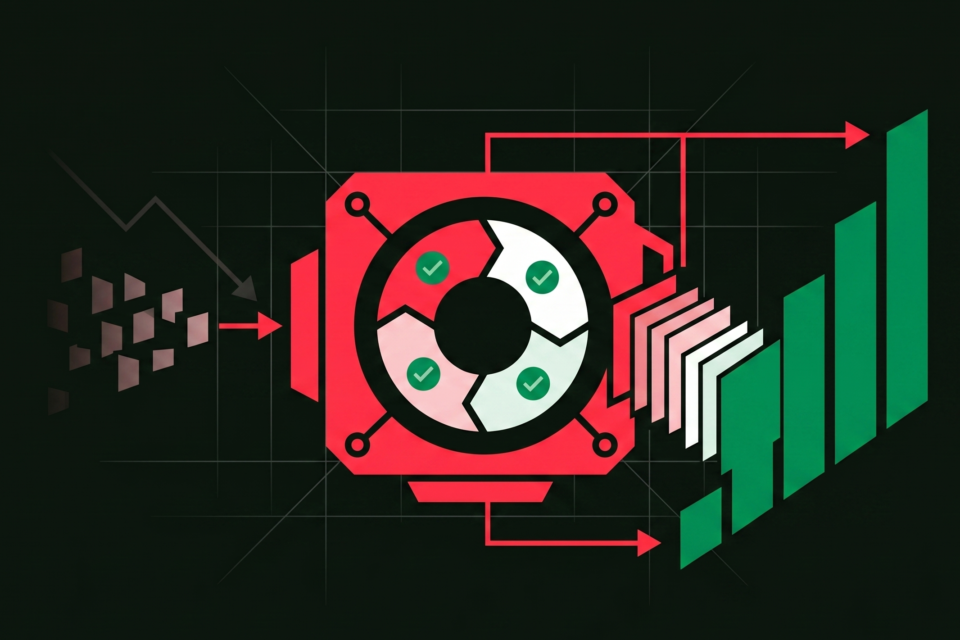
A standard anchor monetizes once: the user lands, the auction fires, a creative loads, and that placement effectively goes quiet for the rest of the session. The reader stays for sixty seconds, three minutes, sometimes longer, while the anchor produces zero additional revenue. MultiAnchor changes that. It rotates creatives inside the same anchor slot on a cadence of four to five seconds, and crucially, each rotation triggers a fully independent auction with the full demand stack behind it. No multi-render. No stacking. No artificial impressions. Just more clean auctions per session, on a placement the user already accepted.
Three things make MultiAnchor smooth where naive approaches are jarring:
The result is a placement that captures revenue across the full session instead of just the first impression, without adding a single new ad slot to the page. In Yieldbird deployments, the net revenue uplift on the anchor placement typically lands between +30% and +50%, and on high-quality inventory with strong dwell time it can reach +70% or higher.
When traffic was growing, publishers could afford to monetize the easy part of a session and let the rest go. That margin is gone. Today, every session that walks in the door has to work harder, because there will be fewer of them next month and the month after.
Publishers who do not adopt a format like this are leaving substantial ad spend on the table. The auctions that should have run in seconds 5, 10, 15, 20 of every session are simply not happening, and the bids that would have won them go to publishers who solved the problem. This is the direction the ad tech industry has been moving for years: more value extracted from each session, proven by engagement and viewability rather than by ad slot count.
And for smaller publishers in particular, this is where lost ground gets recovered. A site that has watched its revenue slip for two years because traffic flattened can often claw back most of that decline by turning one well-positioned anchor into a sequence of auctions. Inventory expands without the page changing. The cake of available ad spend is fixed, but your slice of it grows.
The ad tech market is full of vendors promising +100% uplifts through proprietary AI or secret-sauce optimizations. Most of the time, when you look behind the curtain, the lift comes from places you would not want it to come from: hidden ad slots, multi-render tricks, or simple double-counting of impressions. The number on the dashboard goes up; the risk on the policy side goes up faster, and the lift evaporates the moment Google’s policy team notices the pattern under ad placement policies.
Yieldbird takes the opposite approach. The math behind MultiAnchor is something you can explain to your Financial Director on a napkin: one anchor placement, rotating creatives every four to five seconds, each rotation a fully independent auction with the full demand stack. More auctions per session, on the same placement, under the same policy rules. That is where the +30% to +50% uplift comes from. No black box, no asterisks.
Getting started is straightforward too. Once you are on the Yieldbird Platform, MultiAnchor can be enabled on a single URL or subdomain first, A/B tested against your existing anchor, and scaled from there. The conversation about declining traffic ad revenue stops being abstract and starts being a number on a dashboard, usually within the first two weeks.
Ready to test it on your inventory?
MultiAnchor can be A/B tested against your current anchor placement on a single URL or subdomain before scaling. See the live demo and revenue calculator, or explore the broader Yieldbird Platform to see how Rich Placements fit alongside Prebid Stack, Price Genius, and the rest of your monetization stack.

Karol Jurga
Chief Revenue Officer
See it in action.
Julia Dreślińska
2026-06-30
Read more
Marcin Hajduk
2026-05-15
Read more

Marcin Hajduk
2026-04-29
Read more

Julia Dreślińska
2025-10-24
Read more